

MA-号码: 48930400158
客户反馈 CDMA

Hübsches Exemplar, schnelle Lieferung, gute Verpackung. Vielen DANK !
I was satisfied with my purchase of Ecu. 1742S. is reasonably priced and de...
bonjour bien recu ce matin le 16/10/26 MERCIIIIIIIIIIIIIIIII
Great medal, fast delivery, well packed good communication. Many thanks to ...
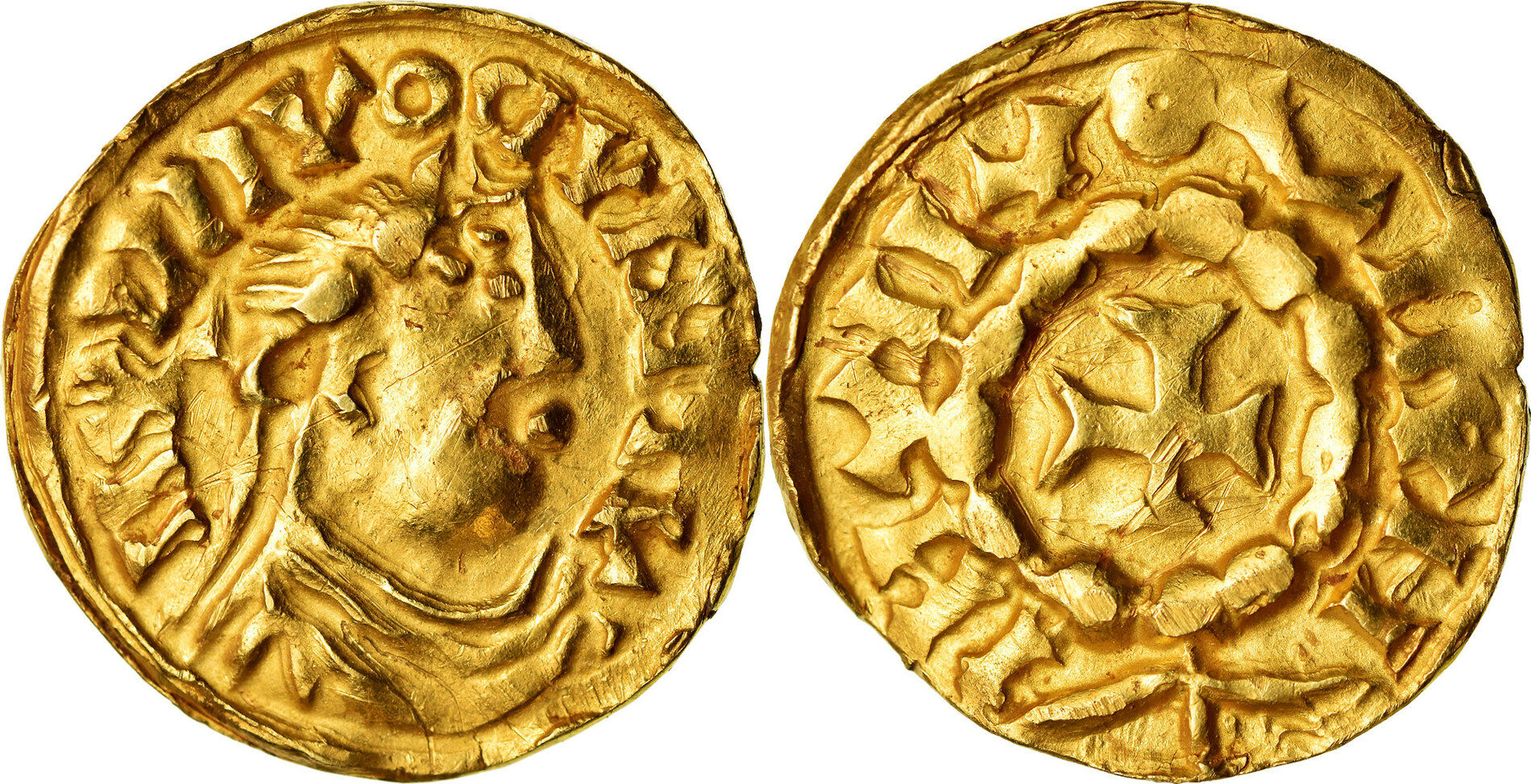
Great Britain Solidus 814-840 Frisia, Louis the Pious, Imitation, Gold EF(40-45)
Comptoir des Monnaies 
16
On MA-Shops since 16 years
49996 评分,
99,7 % 正面Positive (过去24个月)
Worldwide shipping
160,056.87 元21300,00 EUR
Import tax may be added
+ 37.20 元 运费 ( to China )
寄运时间: 8 到 12 天
+ 37.20 元 运费 ( to China )
| +49 (0)2871 2180 383 |
| 支付方式 |
| 电汇 |
Louis the Pious
Degenerate bust of Louis the Pious, laureate and draped, right., Cross in a degenerate laurel wreath., Anglo-Frisian solidus of the highest rarity, utterly fascinating and of significant numismatic importance. A remarkable imitation of a solidus of Louis the Pious (814-840) whose provenance seems to be Anglo-Frisian, with an estimated strike date of around 816 to 818, although it is possible that it was later during the reign of the Carolingian king. It is an imitation of a typical Carolingian portrait of the period, altered for some details, such as the eye, formed of three small pellets shaped like a triangle. It is an imitation of a typical Carolingian portrait of the period, altered for some details, such as the eye, formed of three small pellets shaped like a triangle. The legend on the other hand is a reinterpretation of the original Latin solidii legend (DN HLVDOVVICVS IMP ΛVC / MVNVS DIVINVM) from the engraver's perspective, and it is quite difficult to reconstruct the original Latin wording. Although this superb imitation appears to have been in circulation, its conservation may have been underestimated, as it is possible that the strike of the flans was of insufficient workmanship and quality. Note the wide and thick flan, although slightly bent at 9h. An old cleaning can be seen, presumably dating from the original finding, plus, we note the presence of few scratches on the sides of the coin.This solidus was found in England, in the county of West Sussex (EMC (Early Medieval Coins) n°2019.0140 & PAS (Portable Antiquites Scheme) ID SUSS-2A93DC). For similar types, look at various references: Grierson, cf. type XIV (different dies); cf. MEC I, nos. 752-756 (different dies) and Prou 1075 (different dies). This discovery, made in the area around Aldingbourne, in the district of Arun, is of great interest as it is extremely close to the sea, and bears witness to the commercial exchanges that took place in this region of southern England at the beginning of the 9th century, notably with the French coast and the region of Frisia, which extended between the coasts of today's Netherlands and Germany. Since most of the coins in circulation during this period were made of silver, it is very rare to find these small gold units. Documentation of these coins is gradually increasing, and we can observe that there was an attempt, during this period, to imitate the coinage of Louis the Pious, powerful king of Western Europe, and whose coinage circulated on the coasts of the North Sea, thus appearing to be the trusted trading currency. According to recent surveys, mostly in England, slightly more than twenty imitation coins of the solidii of Louis the Pious have been found, and it seems very rare to find them complete or in such a good state of preservation, and with a good gold proportion, without the coin having been struck with a silver or copper alloy., IIVIIIIVOꓷVИИIV or IIVVIIVODVNNTV, IИVIIVOVIIVH or IHVIIVOVIIVH
Info / FAQ


Information
Online orders are welcome as always and will be shipped directly.
|
Withdraw from contract here 商店主页 | 0购物车 | 使用条件 | 联系 | MA 使用条件 | 隐私声明 | 保证期 | MA-Shops 新商品 Copyright ® 2001-2026, MA-SHOPS Coins All Rights Reserved. Designated trademarks and brands are the property of their respective owners. |